Bonus Myth or #6: “With a resistant scion, you don’t need a resistant rootstock”
 Written by Manus Thoen, Senior Researcher Biotic Trait Discovery
This myth is surprisingly persistent, and not by coincidence. If growers believe that a resistant scion makes a resistant rootstock unnecessary, the demand for specialized rootstocks drops dramatically. Some early industry messages reinforced this idea, often based on short trials that lasted only a few weeks. Those trials never captured what really matters: the long‑term viral pressure that builds up in the root zone.
But biologically and practically, the myth does not hold. ToBRFV is not a polite virus. It does not stay where you expect it. And it certainly does not respect the graft union.
Why resistant scions alone are not enough
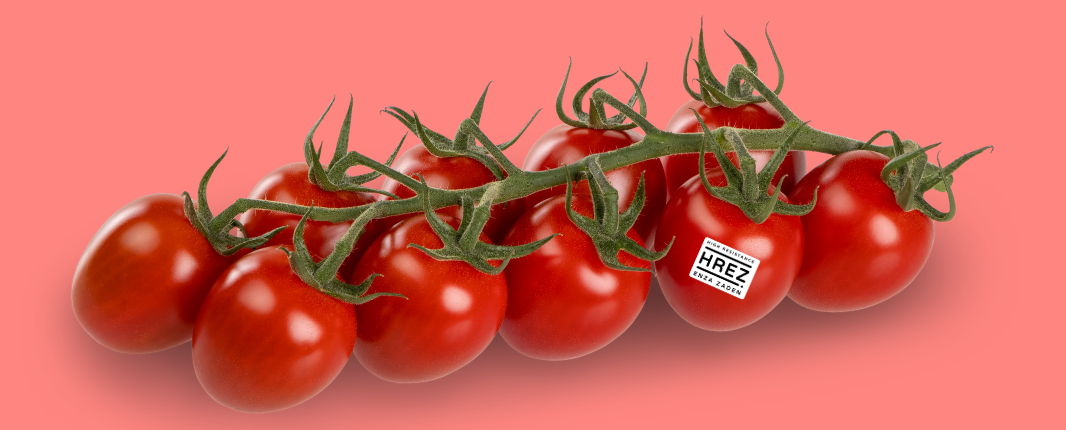
A resistant scion, such as an HREZ hybrid, can block infection in the above‑ground tissues. But if the rootstock is susceptible, the virus can still replicate freely in the roots and in the substrate. That creates a continuous viral surplus, a steady upward flow of virus particles entering the plant through the xylem.
This is not a mild background infection. It is a pressurized pipeline of virus entering the plant every hour of every day.
And here is the key point. No resistance mechanism, not Tm 2², not HREZ, is designed to withstand continuous viral flooding from below. When the rootstock is susceptible, the scion is forced to fight an invasion that never stops.
Emiel Dijkstra, Tomato Rootstock Breeder
“The root zone is one of the biggest virus reservoirs and that’s why we need HREZ rootstocks.”
This is especially true in soil systems, where viral particles from previous crops remain in the ground.
When the battlefield changes
Earlier in this series, we compared HREZ to the Russian army holding off Napoleon’s invasion, burning down a few villages to stop the advancing troops. That metaphor works when the viral pressure is manageable.
But a susceptible rootstock changes the entire battlefield.
Instead of Napoleon’s army approaching from one direction, the root system opens a second front. Virus does not just arrive at the borders. It pours in from behind, through the xylem, in overwhelming numbers. Suddenly the Russian army is not burning down a few villages to stop an invasion. It is forced to burn down the entire continent just to keep up.
Inside the plant, this means the hypersensitive response becomes excessive, especially in fruits where viral accumulation is highest. The plant collapses not because the resistance gene fails, but because the viral pressure is far beyond what any resistance mechanism is designed to handle.
What the data shows
Recent ToBRFV research confirms what growers see in practice. The root system is a major entry point for the virus, and susceptible rootstocks can undermine even the strongest scion resistance.
A 2026 study by Rochsar and colleagues tested graft combinations using Tm‑1‑based resistant materials, not HREZ, and found the same biological principle applies: when resistant scions were grafted onto susceptible rootstocks, the virus was able to move upward from the roots and infect the scion. In contrast, resistant rootstocks significantly limited soil mediated infection and reduced early fruit symptoms in field trials. The effect was even stronger when both scion and rootstock carried resistance. In those combinations, infection rates dropped to around sixteen percent, compared to more than ninety percent in susceptible controls.
A resistant rootstock acts as a barrier
These findings reinforce a simple biological truth. A susceptible rootstock becomes a viral reservoir, continuously feeding inoculum into the plant. A resistant rootstock acts as a barrier, lowering viral pressure before it reaches the scion. And when both parts of the plant carry resistance, the entire system becomes more stable, more resilient and better able to withstand the persistent pressure of ToBRFV.
Mike Lemmen, Global Portfolio Manager
“The best way to protect your crop is to have an HREZ resistant scion with an HREZ resistant rootstock, but this always needs to be combined with good hygiene.“